Editor’s Note: Joel Renner is the CEO of RENNER Ministries. Alongside his father, Joel has actively participated for many years in nearly every facet of the daily operations of the ministry. Joel resides in Moscow, Russia, with his wife and two sons.
Honor
I have been reading a book called “Decoding the Torah” by Rabbi Schneider, and it is an amazing book. In this book, Rabbi Schneider explains how the Old Testament commandments apply to Christians today, and I find it very interesting, so I wanted to share some of it with you.
Today, I was reading about the commandment to honor your father and mother. The Bible says in Exodus 20:12 “Honor your father and your mother, that your days may be long upon the land which the Lord your God is giving you.”
This is not only a commandment, it is a promise. If we honor our parents, then we may have a prolonged life, yet it seems like today, people are forgetting this commandment.
For example, when children call their parents by their first name, it is dishonoring. We only have one set of parents, and we should honor them enough to set them apart by calling them Dad and Mom. Children are the only ones who can call their parents Dad or Mom, and that should be cherished. Another example is when children argue, yell, and scream at their parents instead of loving and respecting them.
I understand that not all situations are the same, and for some children, it can be very difficult to show honor to their parents, but we can still decide not to dishonor them.
Here is an example. Noah had three sons — Shem, Ham, and Japheth. In Genesis 9:18-29, we hear a story about how Noah got drunk one day and became uncovered in his tent. Ham discovered his father uncovered and drunk, and in that moment, he could have honored his father by covering him and leaving, but instead, he did something dishonoring, and for this dishonor he was cursed.
When the two other sons, Shem and Japheth, learned about their father’s situation, they decided to cover their father. They were so respectful that they walked backwards to cover him so they would not see his nakedness, and for this they were blessed.
Today let’s think of ways we can show honor to our parents, because the Bible says our days may be prolonged for doing so, and we all want God’s blessing on our lives.
 God bless,

Joel Renner
Editor’s Note: Joel Renner is the CEO of RENNER Ministries. Alongside his father, Joel has actively participated for many years in nearly every facet of the daily operations of the ministry. Joel resides in Moscow, Russia, with his wife and two sons.
Who Is Your Favorite Person in the Bible?
Oftentimes people will ask someone they admire, “Who is your favorite person in the Bible?” This is a fun conversation, and I’ve been a part of many of these. I’ve heard answers like, “My favorite person in the Bible is Abraham because he is the father of our faith,” or, “Noah, because he built the ark and followed God,” or, “Paul, because he wrote most of the New Testament.” There are so many remarkable people in the Bible. We even see a whole list of righteous people in Hebrews 11, kind of like a biblical “hall of fame” — and the list is quite amazing!
There probably isn’t a wrong answer to this fun question, but no matter who you choose as your favorite person in the Bible, each one was flawed. Every one of them, except for Jesus, made mistakes, and I think this should give us great encouragement because it tells us we don’t have to be perfect to be used by God.
The main thing we must do in order to be used by God is obey. We need to obey what the Bible says and what the Lord asks us to do. And that’s exactly what the righteous people named in Hebrews 11 did. They obeyed the voice of the Lord, and so can you and I! We can’t obey without the help of the Holy Spirit because the Lord will always ask us to do more than we are capable of doing without Him. So remember to always give Him the glory!
We know from reading the Bible that we don’t have to be perfect to be used by God, but we don’t even need to rely on our own strength! One scripture I have enjoyed reading when I feel weak is Second Corinthians 12:9, which says:
…My grace is sufficient for thee: for my strength is made perfect in weakness….
Praise God that the Lord is strong in our weakness! We need the strength of the Lord when we are weak. I encourage you to have faith, stick to the Bible, and obey what you feel led to do as He guides your steps. God will do the rest because He is strong in our weakness!
God bless,
Joel Renner
Editor’s Note: Joel Renner is the CEO of RENNER Ministries. Alongside his father, Joel has actively participated for many years in nearly every facet of the daily operations of the ministry. Joel resides in Moscow, Russia, with his wife and two sons.
Walking in Love and Showing Christ to Your Neighbor
Jesus said in Mark 12:28-34
Now one of the scribes had come up and heard their debate. Noticing how well Jesus had answered them, he asked Him, “Which commandment is the most important of all?”
Jesus replied, “This is the most important: ‘Hear O Israel, the Lord our God, the Lord is One.
Love the Lord your God with all your heart and with all your soul and with all your mind and with all your strength.’
The second is this: ‘Love your neighbor as yourself.’h No other commandment is greater than these.”
“Right, Teacher,” the scribe replied. “You have stated correctly that God is One and there is no other but Him,
and to love Him with all your heart and with all your understanding and with all your strength, and to love your neighbor as yourself, which is more important than all burnt offerings and sacrifices.”
When Jesus saw that the man had answered wisely, He said, “You are not far from the kingdom of God.”
And no one dared to question Him any further.
Wow, this is a big deal. Jesus just said that to love the Lord with all your heart and with all your understanding and with all your strength, and to love your neighbor as yourself is more important than all burnt offerings and sacrifices.
Jesus obviously things how we treat the Lord and each other is important. We all know the Golden rule and it is from Matthew 7:12 and is says “Therefore all things whatsoever ye would that men should do to you, do ye even so to them: for this is the law and the prophets.” So, treat other like you would want to be treated if we did just that we would be in good shape but I think Jesus always calls us to go the extra mile and we know that what ever we sow is what we will reap.
So, if you want forgiveness then forgive. If you want help be a helping person. And when you give or forgive or do anything for your neighbor go the extra mile especially if you are dealing with non-believers so that through your acts they can always say that Christians have something they need.
A good question to ask yourself is: If Jesus was watching me would I be nicer, would I be more polite, would I have been more professional, would I have forgiven?
Joel Renner
Editor’s Note: Joel Renner is the CEO of RENNER Ministries. Alongside his father, Joel has actively participated for many years in nearly every facet of the daily operations of the ministry. Joel resides in Moscow, Russia, with his wife and two sons.
Things to Look Out for When Choosing a Church
Today there are so many Church’s that people can choose from. So, what do people look for in a church:
- Is it close to my house?
- Is the music loud?
- Is the music to religious?
- Is the church old?
- Is the church young?
- Is the church to bright?
- Is the church to dark?
- Are the seats comfortable?
- What time are the church services?
- How long are the Church services?
- How do people dress?
- Do they have children’s classes?
- Is there the teaching of the Bible?
All of these questions are good and the list could go on and on probably for pages. But let me tell you what is the most important part of the church service for me.
To me the most important factor in going to a church is “Do they teach the Bible?”.
The Bible is the inspired word of God. We know this from 2 Timothy 3:16-17 that says “All scripture is given by inspiration of God, and is profitable for doctrine, for reproof, for correction, for instruction in righteousness: That the man of God may be perfect, throughly furnished unto all good works.”
The bible is also a double edged sword and we see this in Hebvrew 4:12 “For the word of God is living and powerful, and sharper than any two-edged sword, piercing even to the division of soul and spirit, and of joints and marrow, and is a discerner of the thoughts and intents of the heart.”
I want the teaching of the bible in my life, my wife’s life, my kids’ life and in my family because it is the inspired by God and is profitable for us to have.
So, if I go to a church that doesn’t have good bible teaching I won’t want to go back. What is interesting is that when you are new Christian the teaching you get is all new to you so most churches would be profitable to you but as you grow you want to learn the deeper things and that tends to move people to either look for someone who can teach the deeper things or it moves people to a church where the teaching is strong.
Of course, in Hebrew 10:25 we see that the bibles says “Not forsaking the assembling of ourselves together, as the manner of some is; but exhorting one another: and so much the more, as ye see the day approaching.” So, we need to go to church in any case but if there is a choice of what Church to go to for me I would go to the church that teach’s the bible.
God bless,
Joel Renner
Editor’s Note: Joel Renner is the CEO of RENNER Ministries. Alongside his father, Joel has actively participated for many years in nearly every facet of the daily operations of the ministry. Joel resides in Moscow, Russia, with his wife and two sons.
How to Pray For Anything
Sometimes I hear people ask, “How do I pray for my wife, kids, boss, job, needs, etc.?” You can probably fill in the blank with several things, but no matter what you are praying about, the best answer I know to give is to pray from Scripture.
When we pray according to Scripture, it ensures that we are praying in agreement with God’s will. And if we still don’t know how to pray, we need to pray in the spirit.
The Bible says in Romans 8:26, “Likewise the Spirit also helpeth our infirmities: for we know not what we should pray for as we ought: but the Spirit itself maketh intercession for us with groanings which cannot be uttered.”
So when we don’t know how to pray — and that can happen at times — we can pray in the spirit and let the Holy Spirit intercede for us. Wow! We should pray that way more often because the prayer of the Holy Spirit is the perfect prayer!
But when we do know what the Bible says about what we wish to pray for, we should use Scripture to pray. For example, if you want to pray for those in leadership, you could pray what the Bible says in Proverbs 21:1, “The king’s heart is in the hand of the Lord, as the rivers of water: he turneth it whithersoever he will.”
Based on this verse, I have often prayed, “Lord, You said that the heart of a king is in Your hand. Lord, please direct him to do righteous deeds.”
When we pray in words that other people understand, it also allows them to add their faith to ours. We know this from Matthew 18:19, which says, “…That if two of you shall agree as touching any thing that they shall ask, it shall be done for them of my Father which is in heaven.” So praying in agreement is a very important thing.
If you don’t know how to pray, pray in the spirit. However, you should also study the Scriptures in order to bring your prayers into alignment with the Bible and allow other people to stand in agreement with you while you pray.
God bless,
Joel Renner
Editor’s Note: Joel Renner is the CEO of RENNER Ministries. Alongside his father, Joel has actively participated for many years in nearly every facet of the daily operations of the ministry. Joel resides in Moscow, Russia, with his wife and two sons.
How to Meditate on Scripture
After times I hear people say I am meditating on a scripture. I used to wonder what does mediating on scripture look like?
Do you sit in a dark room and drink tea in silence and wait for revelation to come? Or do you cross your feet at the fire with coffee and fall asleep in meditation?
I have to say for me to mediate on scripture sounded kind of touchy feely until I saw and heard how my mother would describe meditating on scripture.
Mom wouldn’t use the word meditate (that probably helped me) but she would describe things like this “Joel, I am reading 1 Peter again and I just can’t move on. I am really thinking about the words in 1 Peter. Can I share with you some of my thoughts and the scriptures that I going over” or Mom would say “The words in Revelation that Jesus said to the churches are very strong. I want to understand what Jesus is saying, I am going to study that part of scripture.”
Ask Mom would explain these things to me I learned that to mediate on scripture means to study the word of God. There is reading the Bible and there is studying the bible. They are connected but very different.
We all need to read the word of God on a daily bases but to meditate on scripture means studying a part of scripture. To think about what you read and study who was being spoken to in the text and what is the history around the text and the deeper meaning of the words spoken. This is not going through a daily Bible reading plan. This could be studying the book of Romans and listening to expert teachers on Romans and taking your time to really understand what is being said in the Romans.
In review I believe both daily reading and bible study (mediating) are needed in a Christian’s life.
God bless,
Joel Renner
Editor’s Note: Joel Renner is the CEO of RENNER Ministries. Alongside his father, Joel has actively participated for many years in nearly every facet of the daily operations of the ministry. Joel resides in Moscow, Russia, with his wife and two sons.
Following the Will of God
Today I’d like to share some practical advice for those who are not in ministry but who are serving God.
Everyone who is in ministry today served God before they started to work in full-time ministry. So the first point I want to make is that serving God is very important. Even if you work for a ministry or you are in full-time ministry, you need to serve God by spending time with Him and doing what He asks with a humble and willing heart. This is something you need to prioritize no matter what your job title is.
The second thing that I would like to say is that there is a misunderstanding that somehow you are not serving God unless you are working in ministry. However, I believe that if you work as unto the Lord, you are serving Him. If you are making money and giving to the Lord, you are serving Him. When there is harmony between businesspeople and full-time ministers, it is amazing what can be done for the Gospel. And as believers, we need to fulfill the Great Commission, which is our goal until the Lord returns.
The apostle Paul said in First Corinthians 12:12-27 (ESV):
For just as the body is one and has many members, and all the members of the body, though many, are one body, so it is with Christ. For in one Spirit we were all baptized into one body — Jews or Greeks, slaves or free — and all were made to drink of one Spirit.
For the body does not consist of one member but of many. If the foot should say, “Because I am not a hand, I do not belong to the body,” that would not make it any less a part of the body. And if the ear should say, “Because I am not an eye, I do not belong to the body,” that would not make it any less a part of the body. If the whole body were an eye, where would be the sense of hearing? If the whole body were an ear, where would be the sense of smell? But as it is, God arranged the members in the body, each one of them, as he chose. If all were a single member, where would the body be? As it is, there are many parts, yet one body.
The eye cannot say to the hand, “I have no need of you,” nor again the head to the feet, “I have no need of you.” On the contrary, the parts of the body that seem to be weaker are indispensable, and on those parts of the body that we think less honorable we bestow the greater honor, and our unpresentable parts are treated with greater modesty, which our more presentable parts do not require. But God has so composed the body, giving greater honor to the part that lacked it, that there may be no division in the body, but that the members may have the same care for one another. If one member suffers, all suffer together; if one member is honored, all rejoice together.
Now you are the body of Christ and individually members of it.
So a person fulfilling a service in the workforce is not less or more important than a person in ministry whose job is to share the Gospel. We are all needed, and I can’t say that one role is more important than the other. We each need to be led by the Holy Spirit in what to do with our lives. But as Christians there are several things we are called to do, regardless of our occupation. We all need to pray, give to and participate in our local church, read our Bible, and listen to the Holy Spirit. If we as believers will do these few things, we will be successful in serving God and reaching people with the Gospel.
God bless,
Joel Renner
A Stunning Revelation That the Body of Christ Must Grasp
Editor’s Note: This article has been adapted from Rick Renner’s book Apostles & Prophets: Their Roles in the Past, the Present, and the Last Days.
By Rick Renner
Jesus imparted the divine life of God into the Church’s core when He gave the gift of the Holy Spirit to the disciples (see John 20:22). After Christ did this, the Head and the Body were supernaturally connected, and the Church was filled with the life of Christ Himself — “the fullness of Him who fills all in all” (see Ephesians 1:23). For this reason, the Church really is the living, breathing Body of Christ in the earth today.
According to John 3:34, when Jesus Himself walked the earth, the Father gave Him the Spirit without measure. But Paul stated in Colossians 1:18 and 19 that now, since Christ “…is the head of the body, the church…it pleased the Father that in him [and in all His Body] should all fulness dwell.”
The words “in him” certainly refer to Jesus Himself, but the subject Paul is discussing in these verses is the Church, the Body of Christ. These verses remarkably mean that as God was pleased to give Jesus the Spirit without measure, now the Father is pleased for “all fullness” to “dwell” inside the Church, the Body of Christ — Head to toe.
The word “all” in the phrase “all fulness dwell” in Colossians 1:19 is a translation of the word pan, an all-encompassing Greek word. The word “fulness” is translated from the word pleroma, the same Greek word we saw in Ephesians 1:23 that depicts something that is filled to the maximum.
The word “dwell” in Colossians 1:19 is a form of katoikeo, a Greek word depicting one who settles down into a home and feels so at home there that he has chosen to take up permanent residency. These three words “all fulness dwell” unequivocally mean:
- God’s Spirit has settled into the Church (the Body of Christ).
- He is pleased to permanently dwell there.
- His plan is to fill it to the maximum with the life of Christ.
This stunning revelation is confirmed in Colossians 2:9 and 10, where Paul added, “For in him dwelleth all the fulness of the Godhead bodily. And ye are complete in him….”
The words “in him” in verse 9 emphatically declare that all the fullness of the Godhead dwells bodily in Jesus, but the following verse says, “And ye are complete in him….” In that verse, Paul was speaking plurally to the Church, so these words could be better translated, “And you (plural) have been given that same fullness.” Thus, Paul declared that as the Father was pleased to give the Spirit to Jesus without measure, the Father is now pleased to give that same fullness to Christ’s whole Body, the Church” (see Colossians 1:19).
Individually, every believer carries the Spirit within, but when all the members of the Church are joined to become a larger body, all those various portions of Christ are divinely connected. United, we experience a fullness we cannot know apart from each other. God’s long-term plan is for each member to be divinely joined to others and to function as the real, living Body of Christ in the earth with His heart, His pulse, and His hands and feet in order to touch others and carry the Gospel where it needs to go.
But to bring this plan out of the “mystical realm” into reality, something else that’s divine must occur. This God-breathed plan requires the help of the Christ-given fivefold ministry gifts who are anointed to do their respective parts in assembling and building the Body of Christ so that this Body can house the fullness of the Spirit — the fullness of Christ Himself.
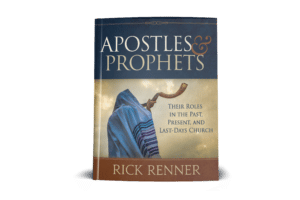 Click here to order Apostles & Prophets
Editor’s Note: Joel Renner is the CEO of RENNER Ministries. Alongside his father, Joel has actively participated for many years in nearly every facet of the daily operations of the ministry. Joel resides in Moscow, Russia, with his wife and two sons.
Starting 2023 Right
The new year has begun! Happy New Year!!!
There is something about the new year that is so exciting. It is a celebration that most people find important. Personally, it is my favorite holiday — probably because it is one of the only holidays that the whole world celebrates, so we are all united that day around one common event. I also like New Year’s Day because it is a time spent with family, a time of anticipation, and then a time of celebration.
But for me, starting the next year right begins before the new year. Every year I take time before the year is over to think about what I have done and what I want to do in the coming year, and I write it down. Some people would call this a New Year’s resolution, but I like what the philosopher Seneca said:
“If one does not know to which port one is sailing, no wind is favorable.”
So setting your compass before you start sailing is important. I suggest you sit down in October and write out the desires of your heart for the new year then come back to this document in November and December and work on it some more and pray about it. As you come back to it, get more and more realistic about your aspirations so when January 1 comes around you will know what you want to do for the year. I recommend having family goals, spiritual goals, financial goals, social goals, physical goals, intellectual goals, and career goals. I have found that one goal per category is needed to cover all the areas of my life — maybe you have one or two more categories that would be helpful to you.
Maybe you don’t like to write out your goals for the year. Well, we are all a little different, but I believe we all have goals, and it is proven that if you write out your goals you are more likely to achieve them. So I urge you to give it a go. I am confident that you would likely encourage your friends or children to write out what they want to achieve, so why don’t you follow that advice too.
The last thing I will suggest to start the new year right is to forgive. It is always the right time to forgive, but I especially want to encourage you to get that courage or humility before the new year starts and forgive anyone you need to forgive. That one act of forgiveness for sure will change the year for you.
God bless,
Joel Renner
The Earliest Historical Use of the Word ‘Church’
The Earliest Historical Use of the Word ‘Church’ The Greek word ekklesia has a rich and meaningful history. One of the earliest appearances of this word was in ancient Athens, where the word ekklesia was used in a political context. This early meaning of ekklesia is significant because the application of its meaning was still in force when New Testament writers used this word to describe the Church of Jesus Christ. The writers of the New Testament clearly understood the meaning of the word ekklesia — a meaning that was far more profound than the one attributed today to its modern English counterpart, the word “Church.” Anyone with a knowledge of the Greek language in the First Century — and certainly this would include Paul — understood the historical, political, and judicial implications connected to this word. It was therefore no accident that New Testament writers used ekklesia to depict the Church and its role in God’s plan. Yet because of this word’s strong political implications, to use it in a separate context was a courageous act at that time. In other words, the use of this word could have resulted in charges of treason against the authors of these New Testament epistles and the church members to whom they wrote. But in Classical Greece, the word ekklesia, which is translated “Church” in the New Testament, denoted a secular assembly of citizens who were invited to participate in a closed assembly in Athens. In this privileged assembly, a variety of functions were performed:
- Laws were created.
- Governmental decisions were debated.
- Policies affecting both internal and external affairs were formulated.
- Key judicial cases were decided.
- Customs and cultural norms were adapted and changed.
- Officials were appointed.
- State decisions were proclaimed.
- Chief magistrates of the land were elected.
Every Athenian citizen was invited to attend the meeting and participate in this ruling body regardless of his class or status in society. Then delegates were called out from their private lives and summoned to take their seats in this distinguished assembly. The Athenian ekklesia was considered the most prestigious group of people in the land, and it was a great privilege and honor to participate in this illustrious ruling body. Its decisions were far-reaching, affecting every aspect of public and private life. The meetings of the Athenian ekklesia were conducted 30 to 40 times a year, and the site for these meetings was a small, artificial platform called the Pnyx in the southwestern district of ancient Athens, near the Acropolis. The ekklesia proceeded to deal with matters of law, public policy, and other business. Sessions frequently included speakers who made eloquent speeches, taught or debated law, argued for truth, or promoted specific agendas on behalf of the wider population. When meetings concluded, a closing prayer and a final sacrifice was offered to the gods. This secular ekklesia was such an integral part of life that famous Greek orators and statesmen — such as Pericles, Aristides, Alcibiades, and Demosthenes — regularly delivered speeches at these meetings. Even Plato referred to events that occurred at Athenian ekklesia meetings in his writings. Political parties and factions were strictly forbidden in this respected assembly. The idea that such an illustrious group could degenerate into a group of contentious factions was an intolerable prospect. There was too much prestige attributed to the ekklesia for its meetings to deteriorate into ugly fights and divisions.
As frequently occurs when people become accustomed to privilege and honor, eventually citizens began to take for granted their right to participate in the ekklesia meetings, and over time attendance at the ekklesia dropped substantially. Many would attend meetings only when they were coerced to do so. It is important to also note that the Athenian ekklesia had different levels of leadership. It had a council that would operate when the ekklesia was not in session, which functioned as a kind of eldership. This council determined what would be brought before the people at the next general assembly ekklesia meeting. In many respects, the levels of leadership in the Athenian ekklesia were similar to the levels of leadership that later emerged in the early New Testament Church The fame of the Athenian ekklesia was so widespread that any educated writer during the First Century would have understood this word’s historical roots and ramifications — including the apostles who penned the pages of the New Testament. The Holy Spirit inspired those writers to use the word ekklesia because it unmistakably means the Church is a body of individuals who have been called out, called forth, and separated for the purposes of God. And just as the Athenian ekklesia ruled in matters of law, business, society, customs, culture, and judicial matters, God expects the Church to exert its spiritual influence in every arena of the society in which it exists. The mere use of the word ekklesia to depict the Church emphatically tells us it was never God’s intention for the Church to be a small group of silent, unnoticed people who gathered to quietly discuss religious affairs. This power-packed Greek word tells us God’s original intention was for the Church to exercise a voice of influence in private and public life. So the concept of the Church, translated from ekklesia, is that of a body of believers as called-out citizens of Heaven who are to apply God’s laws in the affairs of the earth — and to be invited to this distinguished Body is both an honor and a privilege.

Rick Renner