Making A Key Decision in Your Life
By Rick Renner
My friend, I want to help you learn how to make a very important decision in your life. You know, the decisions you make are very important, and you must ensure that you are making correct decisions. And I want to actually ask something of you.
I would ask you to make a decision to read your Bible every day.
Now, what I am not doing is asking you to feel like it, because any time you depend on your feelings before you do something, you’re not going to do it. That’s just the truth. For example, if you depend on your feelings to exercise or diet, then you never will. In the same way, if you depend on your feelings about reading your Bible every day, it will never happen.
So, regardless of how you feel, you must make a decision that just like you brush your teeth every day, you are going to read you Bible. If God wants this of you, then you just do it. It’s a choice that you make.
Now, somebody might say, “Well, Rick, you’re in the ministry. It’s easy for you to read your Bible.” Friend, I want to tell you, the easiest place in the world to backslide is in the ministry. It’s absolutely the truth. Do you know why that is? It’s because in the ministry, you are in holy things all the time and you can easily become very numb or insensitive to the things of God.
You know, I deal with things just like you do. When I wake up every morning, I have messages on my phone and emails waiting for me. I watch the news and receive phone calls. I have all kinds of things that can very easily distract me. So, I’ve had to decide that before any food goes in my mouth, the Word of God is going to go in my heart. I made that personal rule about eleven years ago and I live by it. I just made a decision, and it became a discipline.
You may say, “Well, I’ve tried this and failed, and I don’t even want to commit to do it again because I’ll probably fail again.”
I would encourage you not to give up! God has victory in mind for you, and He wants you to go to new places in your spiritual life.
And look at the words of Paul in Philippians 3:13. He says:
Philippians 3:13
13 Brethren, I count not myself to have apprehended: but here’s what I’m going to do, forgetting those things which are behind, and reaching forth to those things which are before.
When Paul says, “I count not,” it really means to keep a record of what you have done. And even Paul, whom we would say was a spiritual giant, says “Hey, when I look at the facts, I see I’ve not done everything that I was supposed to do. But rather than lamenting it, and moaning, and groaning,” he said:
Philippians 3:13
13 …here’s what I’m going to do. I’m going to forget the things that are behind.
That word “behind” describes something that is obsolete and no longer relevant. It no longer has any application. Paul is saying, “What is behind me, it is in yesterday. It is irrelevant. There’s nothing I can do about it therefore, I’m going to leave it there.”
In fact, he even says he’s going to forget. And that word “forget” is rarely used in the Bible, but it’s meaning is so strong. When Paul says, “Forgetting”, this is literally what he means:
I’m going to turn away from and forget what is behind me. Those things that are irrelevant, I’m going to put them aside. What was in my yesterday, I’m going to deliberately ignore. I’m going to purposely disregard it and completely forget it. It is finished and done away with it. It is obsolete and no longer applicable. It is not who I am today.
That is so powerful! My friend, aren’t you glad that who you were yesterday is not who you are today? That is good news!
You know, it’s just a fact that you cannot fix everything in the past. There are some relationships you cannot restore and some mistakes you made, that you cannot change. There is nothing you can do about it; Some things are already gone and unfixable. But the Bible makes an amazing statement when it tells us in the Book of Ephesians that we can redeem time.
Ephesians 5:16 KJV
16 Redeeming the time, because the days are evil.
Isn’t that amazing? It literally means we can buy back time! And let me tell you how to do it.
When you focus on today, and do what is right today, God will supernaturally help you make up for all of your mistakes and all of your wasted time.
And that’s why Paul says:
Philippians 3:13
13 …rather than live in the past, I’m going to reach forth to the things that are in front of me.
Oh, that is so powerful! “Reaching forth” is a picture of a racer who’s running. He’s not just sitting on the side thinking about running. No, he has jumped into the race, and he’s running toward a definite goal.
And this phrase, “reaching forth” is the picture of a runner who’s reaching hard, pushing forward. His chest is forward and he’s really giving it everything he’s got.
Now, if you’re turning around looking at your past and thinking about everything that you have done wrong and all the mistakes you’ve made, then you’re just living in your past and you are paralyzed from reaching forth into what is before you. If that’s you then make the decision to do what Paul says and forget those things behind and reach forth!
Remember that what happened yesterday cannot be fixed so you must deliberately ignore it, turn away from it and instead look at what is in front of you. Today is in front of you! And God has prepared lot of wonderful things that are right in front of you.
Now, I’ll tell you, in my personal life right now, I can see very clearly what’s in front of me and where I’m going. I can see the goal, and this helps me to make decisions.
When you can see something, it really brings clarity to your life.
Now, I want to go back to making the decision to read your Bible daily. And I want to tell you, when it comes to making that decision, or doing anything for that matter, you need a concrete goal to shoot towards. The Bible is just too big. You might wonder: where do I begin? How much do I need to read?
You need to make a concrete goal because if you don’t have something concrete or something you can see and shoot for, then you will never get started. And I’m going to tell you, that when you get started with any goal, start with something that is realistic. Just start with a few verses, and then, push the goal a little further. You might start off reading a whole chapter. Eventually, you’ll be able to push the goal a little further and read a couple of chapters. Or you could start off reading for five minutes and then move it up to ten minutes. Just do what you can do but have a goal that is achievable.
I am just as busy as you, but I have a concrete plan for every day of my life. And if you have no plan, it’s guaranteed that you will fail.
Now, I want to give you another verse that will support what I am telling you. In this verse, the apostle Paul is talking about how to win any victory. And he says:
1 Corinthians 9:26
26 I run, not as uncertainly; so fight I, not as one that beats the air:
Notice, he says, “I run.” That word “run” describes a runner who has jumped into the race. So, this tells us that first, you got to get in the race.
Grab your Bible. Get a Bible reading plan and jump in the race.
And Paul says —
1 Corinthians 9:26
26 I don’t run uncertainly.
That word “uncertainly” means a person who has no aim, no plan, or no direction. So, Paul tells us this is not the way to run. No, he has a concrete plan and therefore, he knows exactly where he is going.
And then he says:
1 Corinthians 9:26
26 …so fight I, not as one that beats the air.
That word “fight” is the only time it’s used in the New Testament. It’s the word for a “boxer” — a boxer that’s just furiously beating the air. It describes a shadow boxer who is swinging, but he never hits the target because he doesn’t have a goal.
That’s why you need a plan. I can guarantee that if you do not have a concrete goal, one year from now, you will be exactly where you are right now.
And do you know what happens when you stick with a plan, whether it’s reading your Bible, or exercising, or losing weight?
When you stick with your plan, you feel victorious! You just feel like you’ve mastered yourself. Sticking to a plan will just do something for you!
Psalm 119:105
105 Thy Word is a lamp unto my feet. It is a light unto my path.
The Word of God is a light unto our feet and our path. It keeps us on the right path in life.
In Joshua 1:7, concerning the Bible:
Joshua 1:7 KJV
7 Only be thou strong and very courageous, that thou mayest observe to do according to all the law, which Moses my servant commanded thee: turn not from it to the right hand or to the left, that thou mayest prosper withersoever thou goest.
So, here we have the promise, that if you take the Word of God into your heart, you will become prosperous. And why is that? Because the Word keeps you on the right path. It is light to your steps, and it illuminates the way you think. The Bible promises that you will become prosperous when you take the Word of God into your heart. All you must do, is make the decision to continually take in God’s Word.
So, in conclusion I will leave you with this question: “Are you going to make a decision to begin reading your Bible?”
As I have said, life is all about decisions and I believe this is a decision that if you will make a goal and stick to it, will help you make it all the way to the other side of life.
This could be the most important decision that you have ever made.
Do Not Become Callous Continued
By Rick Renner
Last month we discussed why we must have sensitive hearts towards the Lord and not allow anything into our lives that would grieve or disturb Him. The Holy Spirit is a person, and the Bible says He yearns over us with jealousy (scripture- James 4:5?) and so that means we can do certain things or live in such a way that troubles Him and wounds His heart. Remember, we are His creation, He loves us, and He is to be the Lord and God of our lives.
We left off discussing how the Lord refuses to leave us on own through the grace of God. So, if we go wayward and refuse to obey His promptings to return to Him as our first love, does God just abandon us, leave us, and let us go? The answer is emphatic, NO!
What does God do then? How does He bring us to a place where turn from the way we’ve been going and give our hearts once again to Him. You might be surprised. It is through His Grace!
James 4:6 KJV
6 But he giveth more grace. Wherefore he saith, God resisteth the proud, but giveth grace unto the humble.
Where does grace fit in here? Well, it may not sound like grace, but it really is grace. The Bible says —
Romans 2:4 KJV
4 Or despisest thou the riches of his goodness and forbearance and longsuffering; not knowing that the goodness of God leadeth thee to repentance?
And in this case, if you have given your heart to another and turned from the ways of God and started living like the world, He actually begins to resist you. Now, this is the Christian who says, “I know I shouldn’t be over here. I’m not coming back. It’s not so bad.”
If they don’t come back by themselves, James says, “God will get involved, and He will begin to resist that individual.”
James 4:6 KJV
6 But he giveth more grace. Wherefore he saith, God resisteth the proud, but giveth grace unto the humble.
That word “resist” is a military word which means to strategically and methodically oppose in order to crush an enemy. Now, let me tell you, God’s pretty big and if He is against you, you’re in trouble.
But, we are told this in Romans 8:31:
Romans 8:31 KJV
31 What shall we then say to these things? If God be for us, who can be against us?
But if you get on the wrong side with God, He is against you. And when God puts out His arm and tells you to stop, you’re going to stop.
Suddenly, you’ll find the breaks have slowed down your momentum. You discover your success has stopped and you’ll be in a continual state of frustration. You may feel that you’re failing and it’s because God is strategically opposing you —stopping you so you’ll wake up and realize that you must get your heart right with God.
Usually when God begins to oppose somebody, their first thought is to rebuke the enemy. But we must learn that many times, it’s not the devil but God Himself.
I have experienced this in my life on more than one occasion. But friend, I assure you this is God’s grace and goodness at work! It’s as if He says, “Excuse me. You’re not in the spiritual place you need to be right now and I’m going to put everything on pause until you wake up and get it right.”
And when finally we humble ourselves, look what the rest of the verse says in James.
James 4:6 KJV
6 But he giveth more grace. Wherefore he saith, God resisteth the proud, but giveth grace unto the humble.
Hear me now, the very moment we say, “Lord, I have been so wrong and I’m coming back to You.”, Immediately, that hand of resistance is removed. Things begin to work again, the joy of your salvation is restored and you begin to be successful in your endeavors again!
You see, God was never really against you. This was His way of bringing your attention to something that required change.
I have learned in all my Christian life that if Denise and I are feeling frustrated in our ministry, I don’t immediately begin yelling at the devil. Now, we have authority over him because He is under our feet and it could be that He might be trying to mess things up. But before I begin yelling at the devil, the very first thing I do is ask the Lord if there is something that I need to correct. And I’ve found that usually, the answer is yes. And when the correction is made, it is amazing how quickly everything begins to flow.
Now, I want to show you something else. Go to Ephesians 4, because I want to show you the kind of things that will stop you and the kind of things that grieve the Holy Spirit. It doesn’t have to be watching bad movies, getting drunk, or committing adultery.
Look what He says in Ephesians 4:25 —
Ephesians 4:25 KJV
25 Wherefore putting away lying, speak every man truth with his neighbour: for we are members one of another. Be angry, let not the sun go down on your wrath. Neither give place to the devil.
So we see that lying and anger are two things that will grieve the Holy Spirit. And we give him or access into our lives by doing or allowing these things.
Then look at verse 29:
Ephesians 4:29 KJV
29 Let no corrupt communication proceed out of your mouth, but that which is good to the use of edifying, that it may minister grace unto the hearers.
Paul is not only speaking concerning using filthy words. The Greek word used here literally means rotten conversation. So, if in our speech we’re negative, finding fault, criticizing, or gossiping, it grieves the Holy Spirit! That is the form of corrupt communication mentioned here.
Ephesians 4:30 KJV
30 And grieve not the holy Spirit of God, whereby ye are sealed unto the day of redemption.
31 Let all bitterness, and wrath, and anger, and clamour, and evil speaking, be put away from you, with all malice.
This means that even just having wrong attitudes can grieve the Holy Spirit. My friend, we must be careful with how we conduct ourselves. Even our attitudes can affect us and grieve the Lord.
But what does the word “grieve” mean? It describes a spouse who has just discovered that his mate has committed adultery, and he is deeply, deeply wounded.
When Denise and I first got married, we led a ministry which was for people who had been through a divorce. In one year, Denise and I counseled over one thousand brand-new divorcees and we learned about the pain of divorce. And when somebody would come for counseling, I had heard what they said from so many other people that I could almost predict what they were going to say.
One woman would say — “I am so hurt. I gave him my life and bore his children. I supported him and after all that I’ve done for him, how could he do this to me?”
One man would say — “I paid her bills and took good care of her. How could she give her heart to somebody else?”
All of that is this word “grieve”, used in this verse which means, the Holy Spirit who has come to live in us, who longs to have all of us, when we have given our heart to another says, “How could you do this to Me? Have you forgotten that I live in you? I gave you the new birth. I’ve produced fruit in your life. I’ve done so much in your life and after all that I’ve done for you, how can you do what you’re doing?”
It grieves Him.
And just like a wounded lover, sometimes the Holy Spirit’s joy backs up as a means of letting you know that He’s trying to get you to recognize something’s wrong in your life. But if you don’t wake up to it, then the next phase will come, when God says, “You are Mine. You do not belong to the world and if you don’t come by yourself, I’m going to do what I have to do to get your attention, so you get back into right relationship with Me.” And He will resist us until we come to a place of repentance. My friend, it is the goodness of God at work to bring you back into Himself. It is God’s grace at work.
I know some Christians that have troubles all the time, in every area of their lives. And I know what the problem is. It’s exactly what I have been telling you. It’s simply God trying to get their attention to get back into relationship with Him. If they will just listen and obey, things will start going right again!
Even when God resists us, He’s for us. It is His grace and His goodness working to bring us back to the place the Lord knows we are to be. God doesn’t want to resist anybody. He’s for us and wants to bless us. But if we are determined to do what is wrong, He is so good and will refuse us to continue down that path He knows will bring harm to us. That is precisely why He will get our attention and help us make things right again. He is such a good Father!
I want you to evaluate your heart and allow the Holy Spirit to show you areas of your life that require you to make adjustments and change. It’s so simple. It takes seconds to get right with God.
Just pray this aloud: “Father God, I realize that I have done things that have grieved you. I understand now. I ask you to forgive me. I’m coming home. I’m going to make You my priority again and I’m going to do what I used to do. Lord, close my eyes and ears to what is wrong and I ask you to open them to what is right. I ask you this in Jesus mighty name.
If you have prayed this prayer, whether you feel like anything has changed or not, the grace of God has come. He forgives you, He is for you, and He will help you live in a way that brings Him great joy and delight! Forget what is behind you and press into the wonderful future and life that God has prepared for you. It is that easy!
Do Not Become Callous
By Rick Renner
As a believer, you entered into a relationship with the Holy Spirit the moment you became saved. And just like in any relationship, you can hurt or wound the other party by the things you do and say. The Bible makes it clear the Holy Spirit will never leave or forsake you, but when you grieve Him, He will recede. When He begins to recede and be grieved in this way, there’s a lack of joy and excitement in your life. You’ll notice supernatural activity begin to disappear. These signs will cause you to realize something’s wrong. Many times, people immediately rebuke the devil — and sometimes, it is the devil provoking their wrong behavior toward the Spirit of God.
But I’ve learned from my own life that if my joy disappears and I begin to lose my feeling of victory, I need to stop and say, “Holy Spirit, have I done anything to grieve You?” And if I have, I ask for forgiveness. The goal is to become so sensitive to the grievance of the Holy Spirit that you’ll immediately know when you’ve said or done something that has grieved Him.
I remember a specific time in my life when I said something I shouldn’t have said, and at that very moment, I knew my words had grieved the Holy Spirit. Immediately I said, “Holy Spirit, I’m sorry.”
My friends, we need this partnership with the Holy Spirit, and we have to make sure the conduct of our lives never causes Him “harm” or His presence to retreat.
Let’s look at a shocking statement in the Bible found in the book of James. For context, keep in mind that James was speaking to believing Jews in this verse. Even before they were saved, they were good, moral people who tried to obey the Old Testament Law. James 4:4 reads:
Ye adulterers and adulteresses, know ye not that the friendship of the world is enmity with God? whosoever therefore will be a friend of the world is the enemy of God.
It must have shocked these Jewish listeners when James said these words because even before they came to Christ, they would have never committed adultery. In fact, the Old Testament Law, they could be stoned to death for committing the act. So when James called them “adulterers and adulteresses,” it was almost like a slap across the face. I’m sure they were standing there in shock, thinking, What? Why would he call us adulterers and adulteresses?
However, in the original Greek text, James 4:4 only called the Jews “adulteresses.” Why? Because he was speaking to the Church, the Bride of Christ. And in some way, the church James was writing to in his epistle was committing spiritual adultery.
But what is spiritual adultery? To answer this, we have to go back to James 4:4, which says:
…Know ye not that friendship of the world is enmity with God?
Notice the word “frienship.” Used here, the word “frienship” is the Greek word philia, which describes a romantic preoccupation or attraction. Now look at the word “world” in verse 4. In the Greek, “world” is the word kosmos, which describes fashion, society, and the way the world thinks. In the context of James 4:4, these translations tell us that the believers James was referring to were being attracted and seduced by the ways of the world. They were Christians who loved God, but they were allowing their minds to go placed they should never go. They literally felt an attraction to the world.
You must understand that anytime your mind or affection is on something else more than on the Lord, the Bible calls it spiritual adultery. The believers James was addressing were thinking and talking like the world. They were even beginning to adapt to and behave like the world.
Let’s dig a little deeper by examining the next section James 4:4. It says, “…Whosoever therefore will be a friend of the world is the enemy of God.” Specifically, notice James said, “…Whosoever therefore will be….” The word “whosoever” is the Greek word boulomai, which means to advise or counsel. Let’s say you had a problem in your marriage. You might go see a therapist or counselor who would counsel and advice you on your marriage problems. But what’s interesting is that “whosoever” in verse 4 refers to the believers who have sinned as counselors. In other words, these believers took on the role of counselor and advised themselves!
The kind of people James described in verse 4 are those who were filled with the Holy Spirit and at one time loved Jesus and continually had Him on their minds. These believers desired to please the Lord — they read their Bible daily, prayed in tongues, and never missed a church service. But as time passed, they began to let their spiritual disciplines slip away.
That’s exactly how sin begins! No one just wakes up and suddenly wants to commit sin — it’s a gradual transition. As they start to slip, they’ll begin “counseling” or talking to themselves, saying, “Well, I’m too tired today. I don’t always need to go to church. There are plenty of other Christians who don’t go to church every week Maybe it’s okay if I don’t go for a while.” They talk this way to themselves so often that they begin to talk themselves into doing, saying, or thinking something they previously would have never done!
When Denise and I were young adults and living in the United States, Christians woulldn’t go to a movie that had bad words, sex, or violence because they knew it was wrong. We knew our eyes and ears weren’t meant for those thigns, so we didn’t go to those kinds of movies or listen to that kind of music. But gradually, Christians began to talk to themselves, saying things like, I can close my eyes during that scene, or, It’s just a few bad words! It’s amazing to me that in today’s word, Christians will go to movies filled with vulgarity and violence, looking at and listening to those things without being bothered by them — whle just ten years ago, the same Christians would have never exposed themselves to such things!
Let me give you a natural example of how a Christian can gradually become calloused in their heart. When I was learning to write as a child, I pressed so hard on my pencil that I formed a big callus on my finger. When I was at school, I would take a pin and say to the other kids, “Watch this!” While my classmates stared on wide-eyed, I would push that pin all the way through the part of my finger with the callus on it — I couldn’t feel a thing! To this day, I still have that callus on my finger, and it had no feeling in it whatsoever. Why? Because I had put so much pressureon that part of my finger when I was young that it caused it to harden, and it lost its ability to feel. This is precisely what happens to Cjrostoams when they violate their conscience over and over again and grieve the Holy Spirit.
When you do something you know you shouldn’t do, yet you continue to do it, eventually your conscience becomes so callous that what you’re doing doesn’t even bother you anymore. You then begin to see yourself doing and saying things you previously wouldn’t have imagined or even tolerated in the past. Once you violate your spirit and fail to acknowledge it in with an attitude of penitence, you become less and less sensitive to your conscience and to the nudging of the Holy Spirit, and it becomes easier and easier to continue doing those things that violate your spirit and grieve the Spirit of God. You’ll eventually fall out of regular church attendance, your language might become foul, or you might even begin drinking, even though you know it’s wrong and God already delivered you from it. You’re a Christian, but if you continue this life of sin, you’ll begin living in a state of spiritual violaiton.
Once blazing hot for Jesus, you find yourself walking away from Him, just by taking one little step of sin at a time. Eventually you end up caught in the ways of the world — hard, calloused, hardly thinking about the Lord, rarely attending church, no longer giving tithes and offerings, not participating in worship, and thinking of the things and the ways of the world. What happened? Just like James 4:4 describes, you’ve “counseled” yourself contrary to Scripture until finally, you’ve become backslidden.
Let’s look back to the book of James. There’s something noteworthy in the following scripture, which says:
Do ye think that the scripture saith in vain, the spirit that dwelleth in us lusteth to envy? — James 4:5
Most people think of the word “lust” with a negative connotation, but it can actually be used in both a positive and negative sense. In its general usage, it means to yearn over something one absolutely must have. It can describe someone like a drug addict — no matter how much they had yesterday, they’re going to need a brand-new fix every day. A drug addict will lust for their drug of choice and will do anything to get their next fix.
But what does the Holy Spirit “lust” for? Remember, to “lust” means to earnestly crave or yearn for something or someone. Well, the Holy Spirit lusts — yearns — for you and me! When we respond, a divine exchange takes place as we yield ourselves to Him. In return, He delights in filling us with His Spirit.
Take another look at James 4:5. Notice where it says, “…The spirit that dwelleth in us lusteth to envy….” The word “envy” in the Greek is the word phthonos, which describes the feeling a man gets when he discovers his wife has given her heart to someone else. This man discovered his wife’s unfaithfulness, yet he is so committed to his spouse that he won’t divorce her. Specifically, the word “envy” in verse 4 refers to a plan a man must put into action in order to get his wife out of the hands of the one who stole her affections and bring her back into the marital covenant she shares with him. In other words, “envy” can be translated as a rescue operation.
This idea of a rescue operation is depicted in the next verse in James 4, which reads:
But he giveth more grace, Wherefore he saith, God resisteth the proud, but giveth grace unto the humble. — James 4:6
In other words, if you’re not going to repent of being hearhearted on your own, God isn’t just going to stand idly by and let you go your own way. Instead, He says, “You are Mine, and if you’re not coming back on your own accord, I’m going to do something to bring you back. My grace is going to do for you what you’re not willing to do for yourself.” God launches a rescue operation to bring you back from the world and directly where you need to be — in His loving grace and mercy. He will continually work to get the proper response from you and deliver you from a state of spiritual callousness or hardness of heart.
That is one facet of the Holy Spirit’s ministry in the life of a wandering believer — He “…lusteth to envy…” to bring an erring Christian back to a place of humility and tenderness before the Lord.
Cast Your Cares On the Lord
By Rick Renner
I want to help you deal with something we all face throughout our lives, which is the issue of carrying what the Bible calls “cares.” I want to show you from the Bible that you were never meant to carry the weight of this life upon your shoulders and how doing so is detrimental to your life, including your spiritual, mental, and physical condition.
Let’s start by taking a look at First Peter 5:7, which reads,
Casting all your care upon him; for he careth for you.
In this verse, the word “care” describes panic, stress, anxiety, and worries. And the Bible says we are to cast this care upon Him because He cares for you! The word “casting” in this verse describes a man carrying so much weight that it’s too much for him to bear. That weight becomes so heavy that he calls for someone to bring him a donkey. He then comes alongside the donkey and begins to transfer all the weight from his shoulders onto the donkey. The man is still standing and walking. All the problems and weight are still there, but now it’s on the back of the donkey while the man walks alongside. That is where the word “casting” comes from. This is a powerful picture.
My friend, I want you to know that no one is made to carry weight. You can’t go far in life with all that weight. It will begin to crush you, and eventually, you will break. Thankfully, the Bible tells us exactly what to do when challenges come and we are tempted to get into worry, stress, and anxiety.
If you look at Adam and Eve in the Garden, they were not carrying any stress or worry. Cares were not a part of the human experience until after sin and the fall of man. When a person carries the weight of anxiety and stress, it affects them in many ways. You are negatively impacted mentally, your blood pressure is affected, and your bones and body are also put under duress. Do you know why? It’s because you were not meant to carry stress.
In First Peter 5:7 Peter was telling us, “If you’re under a load of worry, call upon Jesus, and push all of that over on Him.” If you walk with Jesus, He will carry it for you!
We all must deal with cares when they come, and I am no exception. I want to tell you a personal story about a time when I struggled greatly over a situation that presented itself in my life. This was right before Denise and I were about to leave for a trip to the United States, and I was ministering on a Sunday morning at our church in Moscow. Just before service, I received an email with a piece of information that disturbed me to the core. As I read it, I immediately felt myself lose my peace and go into a state of complete panic. Now you must understand, I was at the church and read this email just moments away from going onto the stage to preach! So, I came out and smiled. You know, sometimes it takes faith to smile!
But I want you to know I preached all three of those services. I had to keep pressing through my emotions, preaching with joy and smiling, but it was all done by faith because, on the inside, I was having a panic attack.
And when Denise and I got home that night, I found myself falling into a panic attack — something that I had not experienced for many years. I was literally shaking and could not hold my feet still or sit in one spot for very long because I was so inwardly disturbed as I tried to think of what I was going to do.
I learned that sometimes acting quickly isn’t the right thing to do. When you’re upset and you act, you can tend to take the wrong action. But the Lord spoke to me and said, “Rick, don’t do anything. Don’t respond or write an email. Just be quiet.” And so, I let an entire week go by before I answered what had been sent to me. That was a very difficult week, and during this time, my mind was racing so constantly that I couldn’t even sleep. I was carrying extreme weight because of this situation.
But, during that week, I also went to the Scripture in First Peter 5:7 and began transferring this care of mine over to the Lord. I would give it to Him, and then I would start worrying and take back the care. Then, I would realize what I was doing and would transfer it back to the Lord. This continued many times, and I found that what I needed most was for my emotions to be stabilized, so I also began to read from this verse:
Therefore I say unto you, Take no thought for your life, what ye shall eat, or what ye shall drink; nor yet for your body, what ye shall put on. Is not the life more than meat, and the body than raiment?
Behold the fouls of the air: for they sow not, neither do they reap, nor gather into barns: yet your heavenly Father feedeth them. Are ye not much better than they?
Which of you by taking thought can add one cubit unto his stature?
Let me ask you, have you ever seen a bird on a diet or having a nervous breakdown over what they are going to eat? Of course not! Birds don’t worry about those things. They don’t sow or reap; all they do is fly and eat. Now, that’s amazing! I was going through this terrible time of worry, and I read these verses about two hours a day. I read them so much because they were precisely the medicine I needed.
Denise and I were ministering to different churches in the United States. Although we were smiling and talking about trusting the Lord, on a personal level, I was challenged as I dealt with the panic. Yet I kept meditating on the scriptures, and when I saw the words of Jesus in Matthew 6:33, something began to change.
But seek ye first the kingdom of God, and his righteousness, and all these things shall be added unto you.
As I continued to read these verses, I decided: I was going to seek the Kingdom of God first! It didn’t matter what I heard or what anyone said, I was going to choose to believe that according to the Bible, if I seek the Kingdom first, “all these things I need will be added unto me.” I decided that no matter what happens, my life will not be determined by my circumstances. My life is determined by the Word of God and His promises, and He said if I seek the Kingdom first, everything else will be all right!
I read these verses constantly! When I would get a few free moments, I’d open my Bible to these verses. If I found myself beginning to worry, I’d reread them. In all, I must have read them hundreds of times. I had to put them into my heart because I knew I needed them to stabilize me. And over time, that’s exactly what happened. What once brought me into a place of complete panic no longer had the same effect on me, and it’s because I put the Word into my heart until things changed.
At first, all I could see was disaster. My mind was filled with panic, but I would say, “I’m seeking the Kingdom of Heaven and His righteousness first. I’m better than a bird and I’m better than a weed. My heavenly Father knows what I need, and I will not worry about tomorrow. I am laying hold of the altar of God!”
I didn’t know if I could change the circumstance, but I knew I had to change. I had to have peace inside me despite the storm that was going on around me.
My friend, whenever challenges bring you stress, anxiety, care, or concern, you must know your Heavenly Father cares for you. As you focus on Him and put your trust in His Word first, you will find that He will carry that weight so that you don’t have to. You may be going through the worse of circumstances, yet you can still walk through them in His perfect peace. Rest assured that He knows what you need and can be trusted to take care of you and see you all the way through.
You’re Ordained To Live in This Critical Hour
By Rick Renner
Editor’s Note: This article has been adapted from Rick Renner’s book No Room for Compromise: Christ’s Message to Today’s Church
Turbulent winds of tribulation began hitting the Early Church almost from its inception, although the impact was sporadic and was usually confined within the realm of jealous Jewish authorities in certain cities.
Those winds picked up significantly when persecution reached an official level as early as 64 AD, starting with the persecution of Nero. In the years that followed, Church leaders and believers were pounded again and again by sporadic waves of opposition that rose against the truth of Jesus Christ. It was a pattern that would last nearly 300 years.
What began under Nero as a localized persecution in Rome soon morphed into a tempest that eventually affected the Christian community at varying degrees of intensity in every part of the Roman Empire. Over the next three centuries, spiritual storms with devastating turbulence were spawned by many tragic events like Nero’s persecution of believers in Rome. These spiritual tempests spread out across the entire Roman Empire with far-reaching consequences and resulted in the martyrdoms of countless saints in the span of those early years.
The Effects of a Hurricane
To understand the unrelenting nature of the attacks waged against the Early Church and to glean a picture of what lies ahead in our own future, let’s consider the effects of a hurricane. As a hurricane approaches, its impending presence can be felt by the torrent of pounding rain and rising sea tides that precede it. These raging rains and swelling tides can be sufficiently deadly by themselves — but they are merely symptoms of the real storm that is still gathering strength and preparing to hit land. As the massive storm pushes the sea toward land, the swell of the waves grows higher and usually strikes the land before the devastating winds of the actual hurricane. When these rising tides strike the shore, everything in their path is in danger of being ravaged with catastrophic consequences.
Hurricanes consist of multiple belts of rain and wind that pound the land in sequence, one after another, with relatively brief pauses in between each violent phase. Individuals who are caught in the tempest but don’t understand how hurricanes behave may wrongly assume that the storm is calming down after each belt passes. Yet more belts of rain and wind are inevitably on the way to strike with equal or even greater intensity.
When the eye of the storm arrives, the sky may appear blue and clear, giving the illusion that the storm has passed. In this brief moment of calm, some find a false sense of security in thinking the storm is over. Yet in reality, the fiercest impact of the entire storm system is still approaching — on the backside of the eye wall as the hurricane continues to move inland. Some people mistakenly assume that the worst has passed during the eye of the storm. They emerge from their places of safety, not realizing that the hurricane is far from over, and consequently place themselves in harm’s way. Much of the physical and human loss in a hurricane results from people mistaking this temporary calm as a sign that the storm has passed. Because they misread the signs overhead, they face the full force of the hurricane’s backside, getting swept away in the ensuing floodwaters or hit with deadly debris that would have had no effect on them if they had stayed in a place of safety just a little longer.
Yet this is still not the full picture of a hurricane’s impact. Another major outcome of hurricanes is the turbulent weather systems they create in their wake, which affect huge geographical regions. These storms often spawn tornadoes that angrily sweep across large swaths of land or torrential downpours that cause widespread, devastating floods and destroy homes, farmland, and buildings far from where the hurricane first struck land. By the time the storm system has run its course, hundreds or even thousands of square miles have been affected and many people have been displaced, have suffered damage to their personal property, or are missing or deceased.
Persecution in the Early Church
Now let’s apply this illustration of a hurricane to the situation of the Early Church during the first three centuries AD. For hundreds of years, believers were attacked by pounding belts of demonic opposition — and the effects of this tempest were felt far and wide throughout the Roman Empire. At first, the effects were minimal, just as the early winds and rain and the rising tides of a hurricane are merely symptoms of a much stronger, impending force. Yet as time progressed, each wave of persecution intensified, with brief reprieves between the attacks. Finally, the full impact of the storm hit with the persecution of the Emperor Diocletian in the early Fourth Century AD. However, the Church of Jesus Christ resolutely withstood the fierce winds of opposition throughout those three tumultuous centuries, and in 313 AD, the edict of toleration was issued and a final reprieve was given to the Church. Christianity had triumphed over the dark pagan religions of the past.
Since that time, there generally has been a lull from this ferocious storm, at least in Western society, which has given much of the Church the impression that the worst is over. However, the Bible prophesies that a dramatic change in society will occur at the end of the age, which will cause the winds of opposition to rise up against the Church once again with serious consequences.
One might think that once the first 300 years of persecution had subsided, the storm was over — but the truth is, the Church had merely passed into the eye of the storm. Although the clear skies we see today give the illusion that the storm has passed, the strongest winds are still on the horizon. During the more than 1,700 years that have transpired since 313 AD, widespread missionary activity has occurred and brought the Gospel to the ends of the world; many denominations have been established and flourished; and mighty moves of the Holy Spirit have swept large regions of the earth, despite sporadic periods of opposition. It is difficult to think that paganism could ever reemerge in light of these accomplishments.
However, according to the Holy Spirit’s prophetic predictions in the New Testament, the backside of the spiritual storm that struck the Church at its inception will once again slam against society with devastating consequences. Those Christians who are uninformed or ill-prepared or who simply refuse to see what is happening in front of them will be the most adversely impacted. Just as human loss in a hurricane often occurs because people make wrong assumptions about the danger of the storm, those who look at the centuries of the Western Church’s relatively peaceful coexistence with the world and view them as a sign that the storm has passed may be the very ones who face the full force of the storm’s backside.
We must hear what the Holy Spirit is saying to the Church in our own generation. Many prominent Christian leaders and prophetic voices of our day are speaking a common message: that the disturbing legal and moral changes currently taking place in society are signs that the full fury of this end-times storm is fast approaching. Preparation is essential. Thus, it is imperative that we look to the past to learn more regarding what believers faced, endured, and outlasted when the front side of the storm hit them nearly 2,000 years ago.
What Will Happen in the Last Days
Just as a hurricane affects large geographical areas far from where it first hits land, the spiritual storm that will strike in these last days will affect large sections of society. In fact, according to the Holy Spirit’s prophetic alerts, by the time this last part of the storm system has run its course, every part of the world will be affected. Given this inevitability, it is vital to recall the Holy Spirit’s promise in Joel 2:28: “And it shall come to pass afterward, that I will pour out my spirit upon all flesh; and your sons and your daughters shall prophesy, your old men shall dream dreams, your young men shall see visions….”
This prophecy in Joel 2 explicitly calls for a great outpouring of the Holy Spirit’s power in the last days. A mighty outpouring of God’s Spirit occurred at the beginning of the Church Age, and it will occur again at the end of the age. In fact, it will be the greatest outpouring of the Holy Spirit in the history of the Church, reserved specifically for these difficult and challenging times we are entering into. And then when the storm is finally over, we will surely experience that long-awaited moment when Jesus comes back for His Church.
Just as a hurricane arrives in belts of wind and rain with brief pauses in between, there will be deceptive moments in the backside of this impending spiritual storm that will give the illusion that the tempest is over. But it isn’t over until it is over. That moment will come only when Jesus gloriously returns for a Church that is without spot or blemish — a miraculous transformation that only God could perform.
Between now and the time of Jesus’ triumphant return, society will race toward a cataclysmic collision of end-time events that coincide with the backside of the storm. These effects may have been delayed for a season — one in which it may have seemed that the blue skies overhead would last forever. But the spiritual climate is dramatically shifting now, and we are ordained by God to live in this crucial hour. The changes taking place before our eyes will result in one of two choices for every believer: a decision to accommodate the world or a refusal to compromise. Riding the fence will no longer be an option.
Those who yield to temptation and try to accommodate the spirit of the age may avoid the pressure of overt persecution, but they will also lose their capacity to walk in the power of the Holy Spirit. Those who make no room for compromise must be ready to face the backlash of a world that is growing increasingly intolerant of those who believe in and stand for moral absolutes. However, they can also expect to experience the empowering strength of the Spirit of might that will uphold them and see them through to victory in every situation.
You Have Been Chosen
The Holy Spirit did not warn us of these end-time events to scare us — He did it to prepare us. You and I have been chosen and specially ordained to live in this critical hour.
To effectively stand against the backside of the spiritual storm of these last days, we must turn our attention to the message Christ spoke to His church in Pergamum when the front of the storm was first beginning to hit during the latter half of the First Century. We must hear what the Spirit was saying to those early believers. Those men and women of God endured great pressure from an unforgiving pagan society that surrounded them on all sides. At the same time, they grappled with the internal pressure of errant church leaders trying to convince them to conform to the world’s moral standards.
By studying Christ’s message to the church at Pergamum, we will know not only what He commanded and expected of those early believers, but also what He commands and expects of us today. Therefore, I earnestly recommend that you read each page of my book No Room for Compromise: Christ’s Message to Today’s Church with a sober and alert heart. It is imperative that we hear what the Spirit is saying to us in this hour we live in, for this may be the most seriously challenged time the Church has confronted in more than 1,700 years.
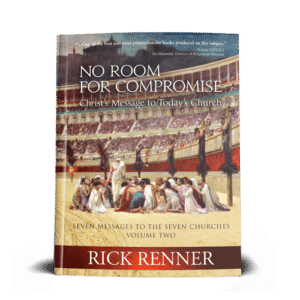
Click HERE to purchase No Room for Compromise:Christ’s Message to Today’s Church
Editor’s Note: This testimony was penned by Erlita Renner in December 2010. Erlita went home to be with her Lord and Savior on February 23, 2021. She so valued her childhood salvation experience — and it happened all because someone in her neighborhood reached out to her. She lived a life thereafter that radiated God’s love as she freely shared with others the message of salvation through Jesus Christ.
I am thinking of the evening in December long ago when Jesus first spoke to me. I had been going to Glenwood Baptist Church in Tulsa, Oklahoma, with a neighbor who lived across the street from me. Her mom and dad and their two daughters went to church every Sunday morning, and they also invited me to go with them for Sunday School. I loved Sunday School, and to this day, I remember the lady who stood in front of our class telling us the stories of Jesus. She would often cry, and I knew that she really was in love with Jesus even though I didn’t know much about the Bible. That lady taught me the love of Jesus.
On that December evening, my aunt had come from Texas for Christmas. She announced that she would like our family to go to church that evening. I asked her, “Can we go to my church? Because the lady who tells the stories every Sunday told me there will be a Christmas tree inside the church, and they will be giving bags of fruit and candy to the people who come. I would really like to go there!”
So my mother, my Aunt Marie, and my brother and sister and I went to church that night. I neglected to tell you that this was in the 1930s during the war when sugar was rationed. It was a big deal to get candy and, particularly, bubble gum. That’s why candy was such a treat!
I remember sitting on the back row and listening to the preacher speak. When he gave the invitation for people to come forward who felt led to receive Jesus Christ as Lord, I was impelled to go. My heart was beating rapidly, and I knew in my heart that the message he had preached was for me. I was young, and this was the first time I remembered an invitation like this. I was sitting by my precious mother, and I told her, “I want to go forward and receive Jesus.” She told me that I wasn’t old enough to understand. I was so disappointed because I felt that I was supposed to go and receive Jesus.
When we arrived back home that evening, my aunt took me back in the bedroom and told me that I didn’t have to be in church to be saved and she knew that the Lord had spoken to me that night.
She prayed with me and I asked Jesus into my heart.
A few years later, I went forward during an invitation and made my decision public and also made the decision to be water baptized. I will never forget that. Immediately, I wanted to tell my mother and all my friends of my decision — I wanted them to share my joy! I was later baptized in that church, and I grew up in that church. I heard message after message and was nourished with the Word of God by my pastor and Sunday School teachers.
When my parents divorced, I became even more committed to the church. I sensed that the people there really served God. Later, I moved to Texas to be with the aunt that prayed for me to receive Jesus as my Lord. She taught me how to serve in my church even though I was a child. I watched her take covered dishes to the Women’s Missionary Union, and I helped clear the tables just to be a helper. Later I made Bible-study tracts for our Training Union, which had a weekly Bible study that we used the tracts for every week. I had a huge desire to learn everything I could about the Bible.
When I returned home from Texas, I went back to my church and I worshiped there every Sunday morning, Sunday night, and Wednesday night. I was also there for all the church functions. That church became my home, and the people there taught me truths from the Bible that have helped me all through my life.
I met a young man in our youth group, whom I later married. Our 54-year marriage was a very good one, and the Lord blessed us with three wonderful children — Ronda, Rick, and Lori. I had the family that I had dreamed of. My children became committed believers. Now my grandchildren are having children and teaching them about the love of Jesus. They, too, are following God! What a blessing!
As life goes on, I am still learning truths from God’s Word and am growing closer to Him. Recently when I was reading my Bible, a scripture spoke to me. It said that God watched as I was being formed in my mother’s womb and that He wrote down in His Book His special plan for me (see Psalm 139:15,16). These verses are amazing! God has plans for us even before we are born!
God is still speaking to me after all these years, and I continually learn new truths every time I read my Bible. After my husband went to Heaven, I often asked myself, What do I do now? I miss my husband so much, but I know God has my plan written in His Book. I am working at RENNER Ministries calling and ministering to our partners, and I have done that for many years — since the late 1980s! It is a great honor to do this. I’m always so thrilled when I get to pray with people and tell them of God’s love for them.
God’s Word is a comfort to me. One of my gifts is the gift of helps. I love it when I get to minister to someone in need — perhaps it’s just a friend that needs someone to care. We can always look into God’s Word and pray when we don’t have answers. I get to do that! Isn’t that great?
I always know that God listens when we pray. This gives me fellowship with Him, comfort when I’m sad, and gladness when I’m happy. We have a wonderful God who cares about all of our needs and He loves to speak to us. I’m so grateful that He called me out when I was a young child. And He still speaks to me and gives me direction and satisfaction! I will always be grateful for the people at Glenwood Baptist Church who reached out to our community through a Christmas tree and a bag of candy and fruit. They were looking for a way to reach people like me and I am a recipient of that outreach!
Erlita Renner — mother of Ronda Renner Roush, Rick Renner, and Lori Renner Stout
Famine, Scarcity & Economic Woes —
Signs of Jesus’ Second Coming
Note: Developed by Harrison House
When the disciples asked Jesus for the sign of His coming, Jesus also foretold that shortages, scarcities, hunger, and deficits of all types would upset the world at the very end of the age just before He returned.
Jesus had already warned about massive deception, wars, terrorism (commotions), nations rising against nations, and kingdoms clashing with other kingdoms. But He continued His discourse on end-time events by telling His disciples, “…And there shall be famines…” (Matthew 24:7).
Famines are certainly not new, as there have been many notable famines in world history. But according to Jesus’ words in Matthew 24:7, there will be a scarcity of food in many parts of the world toward the end of this era just before He returns.
Let’s look a little deeper at the Greek text in Matthew 24:7 to see what is included in this word “famine.” After all, this is a word Christ Himself used to describe events that will occur as the age wraps up and comes to a close.
The word “famines” in Matthew 24:7 comes from a Greek word that literally describes scarcity of grain. Because the word used in this verse is plural, it depicts multiple famines and multiple scarcities that will occur simultaneously in various parts of the earth at the very end of the age. Because “famine” describes a scarcity of grain, it is assumed by most readers that this refers only to physical hunger — and it is absolutely true that Jesus was prophesying that a time of great physical hunger would develop in nations of the world toward the very end of the period. But as you will see, the Greek word for “famine” includes much more than that.
First, however, let’s look at the facts regarding world hunger in our time.
World Hunger Today — The Alarming Facts
The following information is written to give you a brief overview of the recent conditions of hunger in the world today. Because this overview is based on statistics that are valid at the time I am writing this book, it may fall short of the real picture by the time this book comes into your hands. The numbers concerning world hunger are unfortunately growing exponentially.
According to a report from 2016 World Hunger and Poverty Facts and Statistics, more than 250,000 people die every year around the world from hunger and hunger-related causes.[1] Another shocking report is that between 250,000 to 500,000 children become blind each year due to vitamin deficiency caused by extreme undernourishment — and half of those die within a year of their blindness.[2] Besides the people who actually starve to death, millions more languish in undernourished conditions. Instead of living with vibrancy and hope for the future, their lives have halted to a standstill as they focus solely on where to obtain food for themselves and their loved ones so they can continue to subsist.
Think of the famines that have purged millions of people from the planet in various parts of the world — even in our lifetime. The images of starving children and adults have been paraded before us on television and other media to bring the stark reality of this suffering to the forefront of our minds. In many parts of the world, the lack of food and clean water — or the lack of any water at all — is an unimaginable crisis. Despite the wonderful efforts by many charitable organizations, the problems associated with hunger, malnutrition, and disease as a result of no water or dirty water has grown worse in recent years.[3]
Currently our planet has a population of approximately 7.6 billion people. According to the Food and Agriculture Organization of the United Nations, approximately 1 in 9 — or about 815,000,000 people — suffer from chronic undernourishment.[4] That means all these people lack the food necessary to maintain normal health. To help you understand the approximate size of that number, think of the population of the entire European continent — and then add to that the populations of California and Texas combined!
Let’s more closely define what the word “undernourishment” means. The following four points explain the various nuances of this word:
- To be nourished with less than the minimum amount of food essential for normal health and growth.
- To be deprived of the essential elements required for one’s normal and healthy development.
- To live on an insufficient quantity or quality of nourishment that is needed to maintain ongoing health and growth.
- To have insufficient amounts of food to remain in good health.
As I have stated, currently 815,000,000 people are living on less than the minimum amount of food essential for health, growth, and life. In other words, these 815,000,000 people are starving. The greatest number affected are children.
Worse still, according to studies within the last five years, globally 51 million children under the age of five are “wasted,” meaning they have an abnormally low weight-to-height ratio.[5] Of that number, 17 million — that’s fully one third — are severely wasted, meaning the condition is fatal.6 The term “wasted” depicts a person so undernourished that he is dangerously thin, and sickness is caused as a result. Of course, eventually these children will experience death if food and medical care are not provided.
Making matters even worse, hunger creates a vicious cycle. Malnutrition produces poor health, which results in abnormally small body sizes, low levels of energy, and a marked reduction in mental functions. These factors lead only to more poverty. Those suffering are so affected physically that they are not able to learn or to work as adults because their bodies are deprived of needed nutrients and vitamins. All of this downward progression promotes a seemingly unending cycle of even greater hunger.
The facts about poverty are alarming and disheartening. A study of this information makes it very clear why God hates poverty. These statistics expose poverty’s true nature as a thief that steals time, focus, energy, talent, and even life itself. Simply stated, poverty leads to hunger — and hunger leads to more poverty. With- out intervention to stop this sequence of events, the cycle will be unending. What poverty produces is simply devastating — a truth that cannot be exaggerated.
Wars and Conflicts — Contributors to the Hunger Problem
In my book, Signs You’ll See Just Before Jesus Comes, I explain that Jesus prophesied about wars, rumors of wars, commotions, and conflicts — and we see how they have been emerging on a massive scale, just as He said they would in the last days. But now let’s see how all of these military conflicts contribute to advance the horrible condition of world hunger.
A world at war produces one worldwide calamity after another, one of which is famine and shortages of food. Many factors con- tribute to food shortfalls in different parts of the world, but the impact of wars and ethnic, political, and religious conflicts is huge on this heartbreaking issue of famine and hunger.
Exacerbating the hunger issue is the growing number of dis- placed people who live in countries rife with continued conflicts and fighting. As political and religious ideologies collide on an increasing level, the number of refugees is increasing commensurately, and the problem of impoverishment and hunger is growing right along with it.
Right now, there are more than one billion people on the earth who earn less than $1.25 a day.[7] These meager earnings make it almost impossible for them to purchase even small “doses” of food to sustain their lives. World hunger is being felt all over the planet — and it is a sign that Jesus said we would witness just before the end of the age.
What Can We Do to Help Combat This End-Times Problem?
As Christians, most of us understand at varying levels that it is our job to combat the forces of darkness in this world — through prayer, our walk of humility and obedience before God, the proclamation of His Word, etc. But we must also make the effort to combat these dark forces through more natural means. I’m talking about something as simple as opening our wallets and sharing our resources with those in need!
Just reading the information in these paragraphs should be enough to compel us to seek ways to help those who are in need if we are not already doing so. The Bible is full of scriptures about helping the poor and hungry — and promises special blessings to those who obey God’s charge to make a difference in the lives of people in need.
Even if we feel that we are struggling financially, compared to many other parts of the earth, we are blessed! And those who are blessed more than others have a God- given responsibility to hear the cry of the poor (see Proverbs 21:13). We are obligated to do something to make a difference in the lives of suffering people.
If sacrificing financially on behalf of the hungry and needy seems like a daunting goal for you, I’m wondering — would you consider denying yourself a meal once a week and sending the equivalent of that expenditure to a Gospel ministry that feeds the poor? In some places, the cost of one hamburger, a side of fries, and a soft drink could feed an undernourished person for a whole week!
I encourage you to consider making this kind of small investment into the lives of those who lack the basic provision of adequate food to sustain health and growth. This type of com- passionate, sacrificial act will bring a special blessing from God to your life. Proverbs 19:17 declares, “He that hath pity upon the poor, lendeth unto the Lord; and that which he hath given will he pay him again.”
Living in the last days provides opportunities for each of us to reach out and make a difference in the lives of those who are suffering the effects of famine and hunger. Most of these hungry people never asked to be put into these situations. Nevertheless, they live in dire circumstances that are beyond their control. They barely subsist in chaos-affected homes or conflict-affected regions, where fighting, instability, and upheavals of all kinds have caused them to be deprived of basic sustenance for daily living.
Whether our offering is big or small, we must each recognize our responsibility to contribute in some way to make a difference in the lives of people who are undernourished, impoverished, or starving.
Economic Woes —The End-Time Shaking Continues
The horrendous facts of global hunger demand our prayers and our actions, but there is more we must see about this word “famines” as it was used in early New Testament times. What else did this word mean in Jesus’ time — and what does it mean for the days in which we live?
As noted at the beginning of this post, the word “famine” specifically described a scarcity of grain. The economies of Jesus’ day were largely based on grain. That is one reason why nations like Egypt were considered such rich countries — Egypt, in particular, was a huge source of grain in the world at that time. Just think what would have happened if that country had experienced a “famine” of grain in Jesus’ day. A scarcity like that could have plunged the economies of the civilized world into chaos.
In the ancient world, to a large extent, economies were based on grain, so a shortage of grain would have resulted in an eco- nomic shaking. It would have produced a worldwide crisis similar to the shaking we experience in our own day when the value of stocks plummets in a stock market. A shortage of grain would have financially debilitated the Roman Empire in much the same way a crash in the trade markets would affect the world today.
Since so much of the economic system of Jesus’ time was based on grain, that system could very well be compared to the commodities that are sold and traded today as a basis for our world economy. Because of the financial impact this one resource had on the entire Roman Empire, one might say grain was like the “stock exchange” of the ancient world!
So when Jesus used “famines” to forecast a scarcity of grain and widespread hunger in the last days, He was additionally forecasting that a time would come at the end of the age when economic shortfalls and deficits would be so immense that these famines would affect global economies. This was a prediction of financial instability at the end of the age.
Mark’s gospel adds an additional word to this prediction of end-time famines that will give us more insight into Christ’s pre- diction of financial instability in the last days. In Mark 13:8, the writer recorded that Jesus said, “…There shall be famines and troubles.”
The word “troubles” is from a Greek word that means to be troubled, stirred up, agitated, anxious, or upset. It could be translated as the word “distress,” thus picturing people who are distressed about something deeply disturbing or troubling.
Because Jesus used the word “famine” — or scarcity — in the plural form, He let us know that such financial shakings would be repeated again and again. He was prophetically forecasting that financial instability would become more and more common as we draw closer to the end of the age. In other words, the earth at that time in history would exist in a state of being financially troubled, stirred up, agitated, anxious, and upset.
So in addition to hunger itself, Jesus was also forecasting deficits, economic shortages, and financial hardships will affect the earth and serve as another indicator that we are speeding toward the close of the age and the soon return of Christ for His Church.
Should THIS Prediction Frighten Us?
Regardless of what has transpired in the world at any given season in history, God’s people have always been preserved. It will be no different for believers in the last days who embrace their “better covenant, which was established upon better promises” (see Hebrews 8:6). Our faith and trust in Christ’s words — and careful attention to His leading — will hold us steady through any storm of scarcity that affects society and global financial markets in this end-times age.
At the close of the age, people will experience what no other population in history has seen or experienced. Because of this, it is essential that we keep our eyes locked on the promises of God’s Word for every sphere of our lives.
Later in my book (Jesus Before Jesus Comes), I discuss how Jesus prophesied about pestilence and emerging diseases at the end of the age just before He returns.
—Rick Renner
A question I get often is what is the value of speaking in tongues or what happens when you speak in tongues.
Well, if you take it back to the Bible in the Book of Acts, you can see that when people were baptized in the Holy Spirit, they always prayed in tongues — always. That is the biblical pattern. We are biblical believers, and so we follow the pattern laid out in Scripture. When we pray for people to receive the baptism of the Holy Spirit, we can and should expect them to speak in tongues. That is what happened when the church of the book of Acts received the Holy Spirit, and that is what happens when the church of today is filled with the Holy Spirit. It has not changed.
Now, when a person is saved, they become a part of the house of God, the family of God. They are as saved as what they’ll ever be. But at some point, they will experience frustration expressing their hearts when they begin to pray. They will begin to feel a noticeable limitation in their ability to pray. They just won’t be able to express their hearts fully. It is impossible to do so.
But something very powerful occurs when a person becomes baptized in the Holy Spirit. It is as if the Holy Spirit cuts that string that is on their tongue and they then begin to flow out of their hearts like Jesus said in John 7:38 when he prophesied that when the Holy Spirit comes, rivers of living water will flow out of your belly or hearts.
When you pray in tongues, it comes out as a language but not a language taught by man. It will come as a spirit language, straight from the heart of God. That is why praying in tongues is so powerful. We call it tongues but it truly is a spiritual language imparted within us by the Holy Spirit. It is spiritual prayer. All of a sudden, your spirit is able to express everything it was never able to say before. Your spirit is now equipped with the ability to communicate freely without all the hindrances of your mind, emotions or any and all other limitations.
Now, I want you to remember this, I want this to be logical for you. This is not something that is wild or crazy. When you understand the nature of man, it is logical that God would enable us to speak in the Spirit, because we are spirits. We live in bodies but we are spirits, created in the image of God. This is Bible!
So as mentioned previously when we are baptized in the Holy Spirit, God not only empowers us, but it’s like He cuts the string that was on our spiritual tongue, so we no longer have to pray trying to figure out how to express ourselves, but suddenly, out of our innermost being, the spirit begins to speak, as God intended.
So there are those who speak in tongues, and there are those who don’t. If you are born again and Jesus is your Lord, you are saved and in the family of God. But something dramatically changes when you get baptized in the Holy Spirit. The inability of your spirit to speak, is removed and suddenly, your inner man speaks, and your spirit cries out to God.
I will never forget the day this happened to me. My aunt laid hands on me, and I was filled with the Spirit. But I was too embarrassed, or too prideful, to speak in tongues in front of her. But I was so full that it just had to come out! And it doesn’t come out your ears or your nose, no, The Bible shows us that when people get full, it always comes out the mouth.
I was so full, but I just stubbornly refused to speak in tongues in front of her, because I was so shy and embarrassed. But let me tell you, when I was by myself, in a private place, I opened my mouth, and it was literally like a river that came flowing out of me. And I found myself speaking in a language that I did not know. That’s why the Bible calls it, “an unknown tongue.” It was such an extraordinary experience that changed my life forever.
I highly encourage every believer to take advantage of the glorious benefit that comes with being filled with the Holy Spirit and praying in other tongues. This Biblical experience is life altering and will cause you to grow exponentially in your relationship with God. It was for the church in the beginning, and it is for the church of the end times. I want to leave you with this thought: If the early believers needed tongues to start the work of preaching the Gospel to all nations, how much more do we need it to finish the task they so powerfully began?
—Rick Renner
“For God hath not given us the spirit of fear; but of power,
and of love, and of a sound mind.”
— 2 Timothy 1:7
Whether we like it or not, we will have to confront fear in this life. It is unavoidable. Fear comes knocking at the door and looks for every available opportunity to make an inroad into the lives of committed believers, especially those endeavoring to make advancements for the Kingdom of God on the earth. The Early Church was no different. In fact, Timothy had such a spirit of fear come against him at one time that the apostle Paul was compelled to write a letter encouraging Timothy to push beyond his fears and fulfill his God-ordained assignment.
With a spirit of fear upon you — left unchecked and allowed to run its full course — you simply cannot do the will of God. Fear will stop you in your tracks and hinder the work that God has given you to accomplish. But today I want to teach you what the Holy Spirit inspired Paul to write on this subject in Second Timothy chapter 1. I believe this revelation will encourage you to stand strong and free of fear in these last days.
In Second Timothy chapter 1, Paul used the word “spirit” to describe fear, which is very revealing. Fear is indeed a spirit. You can feel it when it comes into the room, and it brings with it panic and dread. But in verse 7, Paul wrote that God has not given you a “spirit of fear.”
The word “fear” is from the Greek word deilia, and it describes something that causes you to retreat and to feel the need to protect yourself. If fear is in your life, you are no longer advancing spiritually. Instead, you are in a position of complete and total retreat because fear carries with it the picture of one cowering and going into hiding. Having a spirit of fear is so dangerous and detrimental to your life as a believer because it paralyzes you in such a way that eventually you can no longer function normally in your life or ministry.
Fear devastates your spiritual life because it robs you of your ability to have a sound or a clear mind. When a spirit of fear is operating in you, you are incapable of thinking soundly. Your imagination runs wild with thoughts of every terrible thing that could possibly happen to you, and then you suddenly begin to picture them like a movie screen in your mind until, finally, you’re seized by that spirit and left completely and utterly incapacitated as a result. But that does not have to be you! Paul wrote in Second Timothy 1:7 that God has not given you a spirit of fear.
So why was Timothy so troubled with fear? What could have unsettled him to such a degree that he had to reach out in such desperation to his spiritual father Paul? To answer this, we must first take a closer look at this point in history. Let me give you a brief background of the book of Second Timothy.
Persecution in the Early Church
Up to this point in time, the persecution of the Church by the Roman Empire was almost non-existent. It was not until the rule of the emperor Nero that a shift occurred and Christians began to be brutally mistreated, assaulted, and martyred for their faith.
Nero came from a long line of wicked and perverse rulers, and he was thrust upon the throne at the young age of 16. He was twisted in every imaginable way, due in part to the horrendous sexual perversion of his family.
I want you to imagine for a moment being handed all the power in the world as a 16-year-old after being told repeatedly by your mother that you were a god and you could do no wrong. Naturally, Nero began to embrace his “divinity.” His depravity knew no bounds, and he viciously eliminated anyone who disagreed with him or challenged him.
Nero was filled with such pride that he truly believed he was the greatest architect (among other things) who had ever lived, and he wanted to design himself a new home. He called it “The Golden Palace” — a house entirely veneered in mother-of-pearl and then covered with gold leaf. That’s why it was called “The Golden Palace.” And this would not be a small home by any means. The house that Nero wanted to build was 300 acres in size.
But there was a problem. Nero wanted to build his house in Rome’s most ancient section where many houses already stood. So Nero went to the Roman Senate and said, “I want to tear down this section of Rome. I want to build my palace.” And they responded, “Nero, you may think that you’re a god, but we’re not going to let you tear down our houses for you to build your palace.”
Undeterred, Nero went to his village just outside Rome, called his servants, and said, “I want you to go into the main circus in the city of Rome, and I want you to set a fire when people are not there so they don’t know what’s happening.” And they obeyed him. The embers began blowing in the air, and soon the entire city of Rome was on fire. By the time the fire had gone out, the section where Nero wanted to build his house was complete rubble. Finally, he could construct his dream 300-acre palace.
Rumors began to circulate throughout the city of Rome that it was Nero who instigated the fire, so the Roman Senate called him for his trial and execution. But while Nero was en route to the Senate, he conceived a diabolic idea. He waited until he was sitting in front of the Senate and they had brought their charges against him. Then he said, “How could you think that I, Nero, would burn down my beloved city of Rome? I can tell you who did this. My spies have brought me information.”
The Senate senators said, “Tell us — who burned down the city of Rome?” And Nero told them, “Christians — this new group, this sect in our town — they have burned down the city of Rome.” Members of the Senate said, “Tell us what you know about these Christians.”
By the time Nero was finished, he had laid out charges so outrageous, yet so convincing, that the senators actually believed him. And for the first time in history, governmental persecution began against the Church in all the Roman Empire’s major cities, including Rome, Alexandria, Antioch, and Ephesus.
Why Was Timothy Afraid?
Well, where was Timothy? He was living and pastoring in Ephesus. And he wasn’t pastoring just any church in Ephesus. No, he was pastoring not only the largest church in the city but the world’s largest church at that time, with probably about 100,000 members. They were living in extraordinary revival — but when the fires of persecution came, it began to reveal those who were not really committed to Christ.
You know, it’s easy to serve the Lord when times are good and it costs you absolutely nothing. But when the fires of persecution come, it always reveals who people really are.
Whether you like it or not, fire comes in life. Fire comes to relationships, ministry, and business. And it’s not fire sent by God — it’s just life. Life brings fire, and sometimes, the enemy brings fire. But despite where it comes from, fire reveals the level of people’s commitment to God.
Suddenly, Timothy, who had been enjoying being the pastor of the world’s biggest church, discovered that some people he thought would always be with him were just “fair-weather” believers — including those he had raised up to be leaders in his church. They were coming to him, saying, “Pastor, we never knew our faith was going to come to this. If we remain faithful, we’re going to lose our lives,” and they began leaving the church.
Timothy went from pastoring a church in revival to pastoring a church in decline. And not only that, but because he was the church’s pastor, he was the most visible and influential Christian in the entire city of Ephesus. He knew that there could be a knock on his own door at any moment, and he could be arrested for his faith. He also knew that if the Roman authorities got their hands on him, they would make his death the most miserable of all in order to make him an example to the other believers who had remained faithful. So it was during this time that a spirit of fear began to work in this man of God, and that is precisely why Paul had to write these words to Timothy:
For God hath not given us the spirit of fear, but of power, and of love, and of a sound mind. — 2 Timothy 1:7
When these words came to Timothy from Paul, he was in a terrible state. He was so hurt by losing the people he thought would always be faithful that he was having a really difficult time giving his heart to others. He couldn’t walk in love because he wasn’t dealing with his own hurt. He couldn’t walk in the power of God because he had been seized by a spirit of fear.
The word “power” used in Second Timothy 1:7 is from the Greek word dunamis. It means dynamite or power, but it’s so much more than that. The word dunamis is used to describe a force of nature — like a hurricane, a tornado, or an earthquake. It is also the very same Greek word that was used to describe the full might of the advancing Roman army — which means that when the power of God is operating in you, you become like a force of nature! You become a spiritual earthquake and can shake things up. You become a dynamic spiritual tornado. You become a hurricane that blows things out of the way. And when the power of God is operating correctly in you, you are like a one-person army with the power to force back darkness. But that power working in Timothy had been inhibited because of fear.
Paul said, “For God hath not given us the spirit of fear; but of power, and of love, and of a sound mind” (2 Timothy 1:7). The phrase “sound mind” is the Greek word sophronismos, which comes from the word sodzo — meaning to save or to deliver — and the word phren the Greek word for your head, your intelligence, or your brain. When you compound the two words, the word “sound mind” — sophronismos — really means a delivered head or a delivered brain. It is a mind that is set free from all inhibitions.
Timothy’s mind was utterly encumbered with fear. He wasn’t thinking freely. He was not the powerful force that God wanted him to be. He couldn’t choose new leaders because he was so affected by those who hurt him. He was not walking in love, power, or a sound mind. Timothy needed help, and desperately at that. Something had to change.
The Power of Remembrance
In verse 5, Paul wrote something very interesting:
When I call to remembrance the unfeigned faith that is in thee, which dwelt first in thy grandmother Lois, and thy mother Eunice; and I am persuaded that in thee also.
— 2 Timothy 1:5
What does “unfeigned faith” mean? The word “feigned” is the Greek word for “hypocrisy” and was used to describe the masks worn on Roman and Greek stages. However, when you translate it as “unfeigned,” it means authentic or genuine — not a bogus or pretend faith, but a real, authentic, genuine faith.
Paul was saying here, “Timothy, I know what kind of faith you have. It’s not bogus or pretend. It is the same kind of faith that was in your grandmother and the same faith that she passed to her daughter, your mother. And now, Timothy, that same living, thriving, real, authentic faith is in you as well.”
Why did Paul feel the need to discuss Timothy’s family history? Why make mention of it? Because Timothy was looking at his future, and all he could see was darkness. He was so taken by the spirit of fear that he was paralyzed by looking at his future. Instead, Paul wanted Timothy to look at his past.
In Second Timothy 1:5, Paul was in essence saying, “Timothy, let’s put the present and the future on pause, just for a moment, and let’s turn around and look at your past. The only reason you have a spirit of fear about your future is, you’re forgetting your past. If you look at your past, you’ll find that God was faithful to your grandmother, and He was faithful to your mother. They both went through very difficult things but made it through everything.” He was telling Timothy, emphatically, “Remember!”
And then he said in the next verse:
Wherefore I put thee in remembrance that thou stir up the gift of God, which is in thee by the putting on of my hands. — 2 Timothy 1:6
The Greek says, “I’m reminding you of these things.” Paul was reminding Timothy of what things? That God’s faithfulness was part of his family’s past!
Paul went on to say, “Wherefore I put thee in remembrance that thou stir up the gift of God, which is in thee by the putting on of my hands” (2 Timothy 1:6).
How do you stir up the gift of God in your life? What did Paul mean by that? Well, to stir up coals, for example, you need a poker. In this verse, we find that God has given every person a poker. It is called “memory.”
This is how you overcome! When your future looks dark and hopeless, you must put yourself in remembrance of the faithfulness of God. Stop looking at how bad it seems right now and set your eyes on every good work of the Lord. That is what Psalms tells us to do too (see Psalm 77:11 and Psalm 111:4).
Time and time again, you have seen the faithfulness of God. He rescued you before, and He will do it again! For example:
- You didn’t think you could pay your bills, but you did.
- You didn’t think you’d ever receive your healing, but you did.
- You didn’t think you’d make it through that trial, but you did.
Friend, I want to put you in remembrance! Regardless of what you are facing now, you have to stir up the gift of God within you and break that spirit of fear off your life. Fear comes to us all, but what we do when that spirit of fear comes against us determines our outcome. God has given us the way out of fear and hopelessness and the way into a life of power, love, and a sound mind. It’s time for us to remember His faithfulness in our lives and stir up our faith!
Today I want to encourage you from Hebrews 10:23, and I want to begin by giving you a little background on this verse.
When the Early Church began, new believers were greatly persecuted. Many people lost their jobs and possessions, and they suffered all kinds of insults. Life became very difficult. At the time the book of Hebrews was written, the Church had been standing in faith for nearly two decades. They had been standing in faith for so long because they were believing God for something.
Are you believing God for something today? Maybe you’re believing for an increase in your finances. Maybe you’re believing for a new job. Maybe you’re believing for your health to improve. Often there comes a time when you stand for so long you grow tired. That’s why it is so important for you to be in a church where you can be surrounded by people who will encourage you.
I get tired sometimes too. That’s why I intentionally surround myself with people who will build me up and strengthen my faith. I know that I need their encouragement. And you need encouragement too.
Hold On to Your Confession of Faith
When the writer of Hebrews wrote to his listeners, he said, “Let us hold fast the profession of our faith without wavering; (for He is faithful that promised)” (Hebrews 10:23 KJV).
What is your profession of faith?
- What are you confessing?
- What are you believing?
- What is your faith saying?
This verse says to hold fast the profession of your faith. “Hold fast” is the Greek word katecho, which is a compound of the two words kata and echo. The first word, kata, describes something that comes down so hard and so heavily, it is overpowering and dominating. The second word, echo, simply means I have, and it is the picture of someone finally possessing something after searching for it for a long time.
When kata and echo are compounded into the word katecho, it literally means to embrace something tightly. It describes someone who finds the object of his dreams and then holds it down — taking control of it and dominating it — even sitting on it so it doesn’t slip away!
Whatever promise God has made to you, whatever you’re hoping for, you have to wrap your arms around it. You’ve got to hold it down and hold it tight because life has a way of trying to take it away from you.
Watch Out for Dream Thieves
At times in our lives, we all face what I call “dream thieves” — thieves that come to steal away the dreams in your heart. They can appear in a variety of ways because the devil wants to throw you off course, and he knows how to use different people and situations to do it.
The devil might speak to you directly and say, “Oh, give up. You’ve been waiting long enough for this.” But other times he may speak to you through family or friends. After sharing your dream, a family member might say, “Give up that dream. You’ve waited long enough for that.” And immediately you feel discouraged. Or, after you’ve waited a long time, a friend may ask you whether you’ve really heard from the Lord.
Other times, the dream thief is simply time. After you wait for so long, time can easily begin to wear away at you, making you feel so weary that you eventually just let go of the dream God put in your heart.
There has not been a single project that I’ve done where dream thieves have not tried to steer me off course. It happened when we built the Moscow Good News Church building, it happened when we built the Riga Good News Church building, and it still happens when I start new projects today.
Things don’t just happen instantly — usually. Most of the time there is a period of waiting. And during that time, we have to wrap our arms around what God has said and hold it tight. We have to make the decision that we’re not going to let the devil or anything else steal that dream from our hearts.
Stay in Alignment With God’s Word
Rather than let the devil steal your dream, come into alignment with what God has said. Hebrews 10:23 says, “Let us hold fast the profession of our faith without wavering….”
This word “profession” (or “confession,” as it is translated in other scriptures) means agreement, and it pictures one who has come into alignment with someone else, or one who has come into alignment with God.
To build our church building in Moscow, I had to be the leader, but it took all of us coming together and getting into alignment with the vision God gave to our church. For years we held fast to the word God had spoken to us; we were believing for the completion of that project.
But there were also moments when I felt myself getting out of alignment. I would begin to think, Are we really going to be able to do this? Each time, it was like the devil was trying to pull me out of alignment by creating doubt in my heart. In those moments, I knew I had to pull myself back into alignment with God. My heart needed to confess what God had said and believe what He said was true.
Surround Yourself With People Who Will Encourage You
During those difficult times, I surrounded myself with people who encouraged me. They told me, “We can do this — we will do this. You’ve done this before, and you can do it again.” And I want to tell you, there is such strength that comes when you reach out for encouragement. It is so important to surround yourself with people who will lift you up, especially in hard times.
Numbers 23:19 says, “God is not a man, that He should lie; neither the son of man, that he should repent.” If God has made a promise to you, He intends to keep His promise to you.
You may have to grow in your faith before you receive the manifestation of what you’re believing for, but as you hold fast to your confession and come into agreement with God, you will see His promise to you fulfilled.
Most of the time it takes everything in me to come into agreement with God. But once I’m in that place of alignment, I can begin to declare and confess the Word of God in faith. And you can too.
The Power of Agreement
In Mark 11:22 and 23, we find Jesus teaching on faith. It says: “And Jesus answering saith unto them, Have faith in God. For verily I say unto you, That whosoever shall say unto this mountain, Be thou removed, and be thou cast into the sea; and shall not doubt in his heart, but shall believe that those things which he saith shall come to pass; he shall have whatsoever he saith.”
Notice that Jesus said, “Whosoever shall say….” Before you do anything else, you have to get faith in your mouth. You need to start saying what God has said and, as verse 23 says, “…not doubt in your heart.”
The word “doubt” means to hesitate, to waver, or to differ. In this verse, Jesus is saying when a person’s heart does not differ from what his mouth is saying, that combination of agreement will always make things happen!
I’ll give you an example from my life. When I was younger, I went to a big church meeting where people were giving testimonies about how their eyes had been healed. God did not speak to me — I had no faith for what I was about to do — I just had an empty heart and a mouth filled with words.
I said, “Well, if they can be healed, I can be healed.” So, I took off my glasses, placed them on the floor, and crushed them under my feet.
I did not have a revelation, and God did not tell me to do that. I just did what somebody else had done. And when I was driving home that night, I realized I was a dangerous weapon on the road. I didn’t have any faith for what I had done — and, on top of that, I couldn’t see!
My point is this: If you do not have faith in your heart, you can have a mouth filled with words that sound right but have no faith. Your heart and your mouth have to be saying the same thing. When you get the faith in your heart and the confession of your mouth into agreement, it has the power to move mountains.
Know What You’re Believing For
Look again at Hebrews 10:23 — “Let us hold fast the profession of our faith without wavering; (for He is faithful that promised).”
What are you believing for? What are you hoping for? Is it the salvation of your spouse? Is it an increase in finances? Then you must wrap your arms around that hope and hold it down. Put all your weight on top of it because life will try to take that hope away from you. You’ve got to wrap your arms around it and hold on. And the Bible says to do this without wavering.
The word “waver” denotes someone who is bowed down or bent over. It describes someone who is so tired that he can barely stand or someone so exhausted that he simply gives up. It gives us a picture of someone who started out strong in his faith but then over time let go of his faith because this person began to wobble in what he believed.
That doesn’t have to be you. You can stand strong in your faith to the very end.
Stand Strong to the End
How do we stand in faith without letting go? I want you to look at the very last verse of Hebrews 10. It says, “But we are not of them who draw back unto perdition; but of them that believe to the saving of the soul” (Hebrews 10:39).
This verse is describing people who at one time were moving in the right direction but then let loose of their faith because they began to waver in what they believed. The Bible says they “drew back into perdition.”
The word “perdition” describes something so ruined and rotten that it is decomposing. In fact, it can be used to describe a piece of rotting meat filled with maggots.
Here’s what the Bible is telling us: If you don’t stand strong in your faith, the devil will take you down until you say, “Oh, I don’t believe that anymore. I tried that. I stood, and I waited. Now I’m done.”
People with this experience tend to become very bitter about believing God. They can become like spoiled individuals — ruined by bitterness. And once someone gets into that position, they are usually very difficult to help.
Don’t let that happen to you! What God promises, He WILL perform. It may take a while for that promise to come into manifestation, but it will come.
So I want to ask you today: What are you believing for? Are you believing for the salvation of your spouse? The redemption of your children? For your finances to turn around? Are you believing for a better job or for the healing of your body?
Whatever you are believing for, find out what God’s Word says about it, get your heart and mouth into agreement with that promise, then hold on to it — hold fast until you receive the manifestation you’re believing for.
God will answer your prayer, so make the decision today to keep standing no matter how long it takes.